If you've spent any time looking at homes for sale in Boise, you've probably noticed that property taxes can vary quite a bit from one listing to another. Two homes with similar asking prices may have noticeably different annual tax bills, even when they're located in the same general area.
That's because Idaho property taxes aren't based on purchase price alone. Assessed values, exemptions, and local taxing districts all factor into what a homeowner pays.
For buyers relocating to the Treasure Valley, Idaho's system may also look different from what they're accustomed to. And for current homeowners, a change in assessed value can raise questions about what their property is worth and whether their tax bill is accurate.
Here's how Boise property taxes work, what affects your bill, and where to find reliable information about a specific property.
How Do Property Taxes Work in Boise, Idaho?
Property taxes help fund many of the local services Boise residents use, including schools, city and county services, fire protection, and libraries.
Although we often refer to them simply as "Boise property taxes," several different agencies are involved.
The Ada County Assessor determines property values for tax purposes. Local taxing districts establish their budgets and property tax levies within the requirements of Idaho law. The Ada County Treasurer handles billing, collection, and distribution of property tax revenue.
The Idaho State Tax Commission provides statewide oversight of the property tax system, but it doesn't collect individual homeowners' property tax payments.
Knowing which office handles what can save some frustration. Questions about your home's assessed value or homeowner's exemption generally belong with the Assessor. Questions about your bill or making a payment belong with the Treasurer.
For a broader explanation of the state's system, the Idaho State Tax Commission's property tax guide explains how assessments, taxing districts, and tax collection work together.
How Are Property Taxes Calculated in Ada County?
The calculation starts with your property's assessed value. Any applicable exemptions are deducted to determine its taxable value.
That taxable value is then multiplied by the property's consolidated levy rate, which combines the applicable property tax rates from the taxing districts serving your property.
These districts may include the city, county, school district, and other local taxing entities.
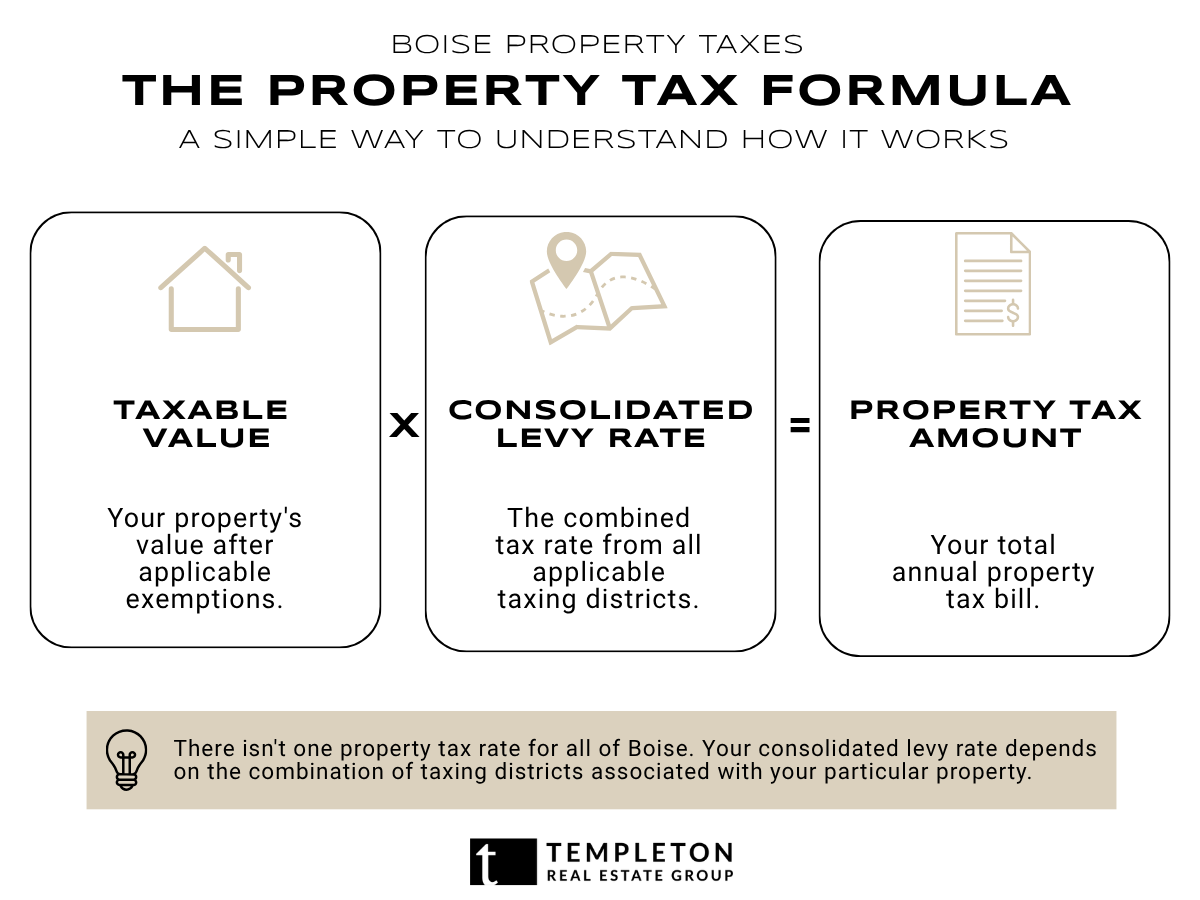
For a more detailed explanation of the calculation, visit the Ada County Treasurer's Calculation of Property Taxes resource.
An Example of How Boise Property Taxes Are Calculated
Let's use a hypothetical Boise home assessed at $500,000.
If the owner qualifies for the full Idaho homeowner's exemption of $125,000, the calculation would look like this:
- Assessed property value: $500,000
- Homeowner's exemption: -$125,000
- Taxable value: $375,000
The property's consolidated levy rate would then be applied to that taxable value to calculate the property tax amount.
This is a simplified example, not an estimate for an actual Boise property. It illustrates the difference between assessed value and taxable value, which becomes especially relevant when comparing homes.
How Much Are Property Taxes in Boise, Idaho?
There isn't a single number that accurately represents what every Boise homeowner pays.
A property's assessed value is a major factor, but exemptions and taxing district boundaries can make a substantial difference. A home within Boise city limits, for example, may be subject to a different combination of taxing districts than a home in an unincorporated portion of Ada County.
Local budgets and voter-approved levies also affect property tax obligations.
This is why a general Boise property tax average only tells part of the story. If you're considering purchasing a particular home, its individual tax history is a more useful starting point.
You can research that information through the Ada County Treasurer and review property assessment details through the Ada County Assessor.
Keep in mind that the previous owner's tax bill isn't necessarily what you'll pay after purchasing the property. We'll get into that distinction below.
How Does Ada County Determine Your Home's Assessed Value?
Idaho generally requires real property to be assessed at 100% of its market value before applicable exemptions.
To determine that value, the Ada County Assessor considers property characteristics and market information. Location, square footage, construction quality, age, condition, improvements, and relevant sales can all play a role.
Your assessed value can change even when you haven't renovated or made significant improvements to your home. Market conditions alone may affect the valuation.
Unlike some states, Idaho doesn't establish a fixed annual percentage cap on increases to an individual property's assessed value.
Is Your Assessed Value the Same as Your Home's Market Value?
They're related, but they aren't interchangeable.
The Assessor's valuation is intended to reflect market value for property tax purposes. It isn't a substitute for a current real estate market analysis, particularly if you're preparing to sell.
Consider a home that has recently undergone significant updates, or one competing against several similar properties in the same neighborhood. Those details can influence how buyers respond to the home and what they're willing to pay.
An accurate listing strategy looks beyond the assessed value to recent comparable sales, competing properties, condition, and current buyer demand.
If you're curious about what your home may sell for, our article How Much Is My Boise Home Worth? explains the factors that influence local market value and why different valuation methods can produce different results.

How Often Does Ada County Reassess Property Values?
Ada County assesses property values annually. Idaho also requires counties to physically inspect properties on a rotating schedule, with each property inspected at least once every five years.
That five-year inspection cycle doesn't mean your assessment stays unchanged between visits. Annual valuations can still reflect shifts in the market and updated property information. For information about your property's assessment, visit the Ada County Assessor's Office.
What Is the Idaho Homeowner's Exemption and How Does It Work?
One of the first things Boise homebuyers should understand is Idaho's homeowner's exemption. Qualifying homeowners can exempt 50% of the value of their primary residence and up to one acre of land, with a maximum exemption of $125,000.
That exemption is applied to the property's taxable value, not directly to the tax bill. In other words, a $125,000 exemption doesn't mean your taxes decrease by $125,000. It means that amount is excluded from the value used to calculate your property taxes. For a homeowner purchasing a primary residence, this can make a meaningful difference in the taxable value of the property.
Who Qualifies for Idaho's Homeowner's Exemption?
Generally, you must own and occupy the home as your primary residence. Applications are submitted through the county assessor's office, which reviews eligibility and approves qualifying properties.
Once approved, homeowners ordinarily don't need to submit a new application every year. The exemption generally remains in place until ownership changes or the property no longer qualifies. If you've recently purchased a home in Boise, it's worth confirming that your exemption has been properly established rather than assuming it happened automatically during closing.
What Changed With Idaho's Homeowner's Exemption in 2026?
Idaho made an important change to the homeowner's exemption beginning with the 2026 tax year. Under House Bill 843, the state eliminated the proration of the exemption based on when an eligible homeowner applies during the calendar year.
According to the Idaho State Tax Commission's April 2026 guidance, eligible homeowners who apply before the close of business on the last business day of the year can qualify for the full exemption for that tax year. The maximum exemption remains $125,000, subject to the 50% limit on qualifying value. This is worth knowing if you purchased a home during 2026 or are planning to purchase before the end of the year.
For eligibility details and application requirements, contact the Ada County Assessor.
Do Property Taxes Change When You Buy a Home in Boise?
They can, but purchasing a home doesn't automatically establish a new tax amount. The annual property tax figure displayed on a real estate listing is useful background information. It isn't a guarantee of what the next owner will pay.
A few things can account for the difference.
The Previous Owner May Have Qualified for Exemptions
The seller may have received the homeowner's exemption or another form of property tax relief. Your eligibility could be different, particularly if you're purchasing the property as a second home or investment property rather than a primary residence. It's worth confirming which exemptions are reflected in the existing tax information and which may apply to you.
The Property's Assessed Value Can Change
Ada County reassesses property values annually, so the taxable value may change from one year to the next. Your purchase price can provide relevant market information, but it doesn't automatically become the property's next assessed value.
The Consolidated Levy Rate Can Change
Property tax rates are influenced by local taxing district budgets and taxable property values. Voter-approved measures can also affect future tax obligations. Because the consolidated levy rate reflects the applicable taxing districts for a property, it can change from one tax year to another.For these reasons, a previous tax bill is a starting point, not a reliable promise of future costs.
Why Is the Property Tax Amount on a Boise Real Estate Listing Different From What I Might Pay?
Most real estate listings display an available historical tax amount associated with the property. That figure may reflect the previous owner's exemptions, an earlier assessment, and tax rates from a prior year.
If you're relocating to Boise, be especially careful about assuming Idaho property taxes will work the same way they did in your previous state. Before making an offer, review the property's current assessment and tax information. Your lender can also help you understand how anticipated property taxes may affect your estimated monthly payment.
When Are Property Taxes Due in Ada County?
Idaho property taxes are generally billed once a year, with tax bills mailed in November. Homeowners can typically pay the full amount by December 20 or split the payment into two installments.The standard schedule is:December 20: Full payment or the first half of the property taxes is due.June 20: The remaining balance is due the following year if paying in two installments.If a statutory deadline falls on a weekend or legal holiday, the applicable due date may be adjusted.For your exact balance, payment options, and current deadlines, visit the Ada County Treasurer.
Are Boise Property Taxes Included in Your Mortgage Payment?
For many homeowners, yes. If your mortgage includes an escrow account, your mortgage servicer typically collects a portion of your anticipated property taxes with each monthly payment. Those funds are then used to pay the taxes when they're due.
This is also one reason your monthly mortgage payment can change even if you have a fixed interest rate. If property taxes increase, your servicer may need to collect more money to cover the anticipated bill. Reviewing your annual escrow analysis can help you see where those adjustments come from.
What Should Boise Homebuyers Know About Property Taxes Before Purchasing?
Property taxes deserve a place in your homebuying budget alongside the mortgage payment, homeowners insurance, and any applicable HOA fees. Before purchasing a home in Boise, take a few minutes to look beyond the annual tax amount shown on the listing. Review the current assessed value, the exemptions reflected in the property's tax history, and whether you're eligible for the homeowner's exemption. Your lender can help you estimate the monthly payment using anticipated property taxes rather than relying solely on the previous owner's bill.
If you're comparing several homes, those differences may affect the total cost of ownership more than you initially expected. It's one more reason to evaluate the property itself, not just its asking price. If you're beginning your search, explore Boise homes for sale, and take a closer look at the properties and neighborhoods that fit your plans.
Frequently Asked Questions About Boise Property Taxes
What Is the Consolidated Levy Rate in Ada County?
The consolidated levy rate is the combined property tax rate for all applicable taxing districts associated with a particular property. It is applied to the property's taxable value to calculate the property tax amount. Because taxing district boundaries vary, the consolidated levy rate isn't necessarily the same for every home in Boise or Ada County.
Are Boise Property Taxes Based on the Purchase Price?
Not directly. Idaho property assessments are generally based on market value as determined by the county assessor. A recent sale can provide relevant market information, but the purchase price doesn't automatically become the property's assessed value or determine its tax bill.
How Often Are Property Taxes Reassessed in Idaho?
daho counties assess property values annually. Physical inspections occur on a rotating schedule, but assessed values can change between inspections as market conditions and property information change.
Does Idaho Have a Property Tax Exemption for Seniors?
Idaho's Property Tax Reduction Program may provide relief to qualifying homeowners age 65 or older, among other eligible groups. Income, homeownership, property value, and other requirements apply. Age alone doesn't automatically qualify someone for a reduction.
Do Property Taxes Automatically Increase When You Buy a House?
No. A change in ownership doesn't automatically establish a specific increase in property taxes. Future taxes depend on assessed value, applicable exemptions, tax rates, and other relevant factors.
Where Can I Look Up Property Taxes for a Boise Home?
You can research property tax and assessment information through Ada County's official resources. The Treasurer handles property tax billing and payment information, while the Assessor maintains property assessment records.
Are Boise Property Taxes Included in Your Mortgage Payment?
They may be. If your mortgage includes an escrow account for property taxes, your mortgage servicer generally collects funds through your monthly payment and pays the taxes when due.
Buying or Selling a Home in Boise? Know the Numbers.
Property taxes are one part of the financial picture, but they're worth understanding before making a real estate decision. If you're buying, that means looking beyond the tax amount displayed on a listing. If you're selling, it means recognizing that your assessed value and your home's current market value aren't necessarily the same.
At Templeton Real Estate Group, we help buyers and sellers make sense of the Boise market with property-specific information, local experience, and a strategy built around their individual circumstances.
Whether you're relocating to the Treasure Valley or preparing for your next move, we're here to help you understand your options and what comes next.
Templeton Real Estate Group
📞 208-473-2203
📧 Info@TempletonRealEstateGroup.com
This article is provided for general informational purposes and is not intended as tax or legal advice. Property tax laws, exemptions, rates, and deadlines may change. For information about a specific property or your eligibility for tax relief, contact the Ada County Assessor, Ada County Treasurer, or a qualified tax professional.